The Mooney Mansion: Walhalla Ravine’s Most Famous Ghost Story
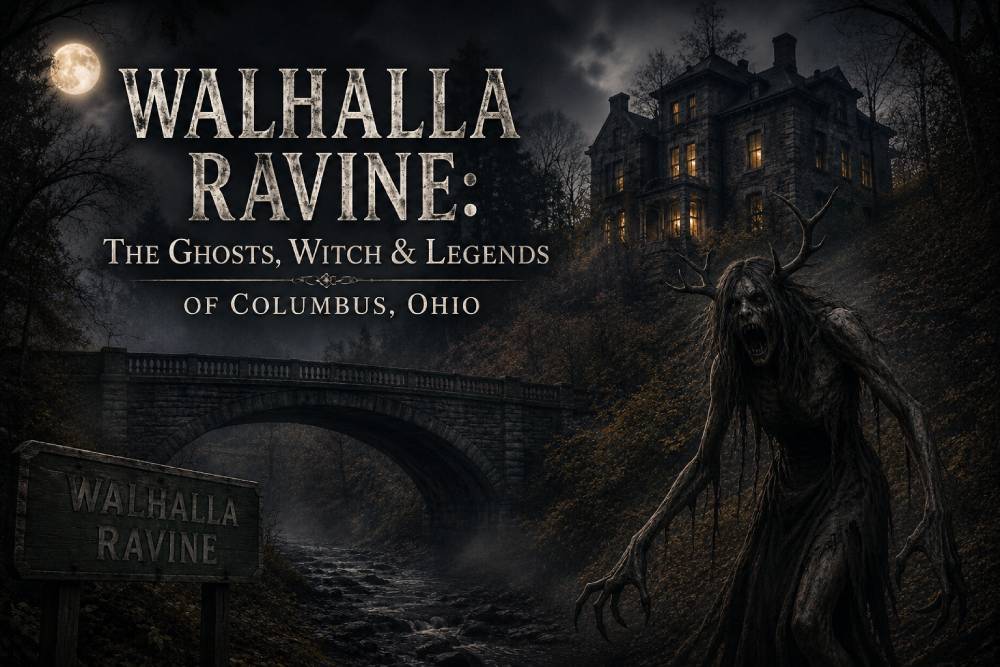
Of all the ghost stories associated with Walhalla Ravine in Columbus, Ohio, none is more famous than the legend of Mooney Mansion. For generations, people around Clintonville have repeated variations of a gruesome story involving a local doctor, his family, an axe, the mansion overlooking the ravine, and the Calumet Street bridge. The details change depending on who tells the story, which is part of what makes the legend so interesting. The story is established enough in Columbus folklore that Ohio State University has even referenced Mooney Mansion in coursework about the study of legends and folklore.
According to one of the most common versions, Dr. Mooney supposedly murdered his wife and daughter inside the mansion, with some retellings claiming he then killed himself. Another version claims members of the family were hanged from the bridge overlooking Walhalla Road. Over time, even stranger details became attached to the story: mysterious blue lights appearing inside the mansion, reflections of the murdered family visible in the water beneath the bridge, and even a statue said to bleed from wounds corresponding to the supposed murder.
But Did the Mooney Mansion Murders Actually Happen?
This is where the history becomes just as interesting as the ghost story: the famous murders appear never to have happened.
Researchers with the Ohio Exploration Society report finding no newspaper accounts or public records supporting a murder at the property, while people who lived in the area during the supposed period reportedly did not remember such a crime occurring. Clintonville History likewise describes the tragedy associated with the house as false.
There was, however, a real Dr. Charles M. Mooney associated with the property. A 2024 Columbus Dispatch student journalism project traced his obituary and found that Dr. Mooney died at his Walhalla residence in 1944 at age 74 after an illness. More importantly, his wife and three children survived him. His wife, Derrie Mooney, lived until 1975. That makes the familiar story of Dr. Mooney murdering his family in the 1950s impossible.
And yet, the legend survived.
That may be the most fascinating part of the Mooney Mansion story. An imposing house overlooking a secluded wooded ravine, a bridge, darkness, and generations of neighborhood kids provided nearly perfect ingredients for an urban legend. Details changed as the story passed from one person to another, but the basic tale became so firmly associated with Walhalla that it remains one of Columbus’s best-known ghost stories, even after the historical events behind it were disproven.
The murders may not have been real. The legend unquestionably is.
The Witch of Walhalla Ravine
Among the stranger and lesser-known stories surrounding Walhalla Ravine is the legend of a mysterious woman who supposedly lived somewhere within its wooded hillsides. Unlike the famous stories surrounding Mooney Mansion, the tale of the Walhalla Witch has largely disappeared from modern retellings, surviving mostly through scattered memories and local folklore.
One version of the legend places the woman in the ravine sometime during the 1950s or 1960s. Children in the surrounding neighborhoods supposedly knew about an old woman who lived alone in a small house or shack hidden among the trees. Parents warned their children to stay away from her, although nobody seemed entirely certain what she had done to deserve such a frightening reputation.
Naturally, telling children not to investigate only made the mystery more interesting.
Stories began circulating about children venturing into the woods looking for the woman’s home. She was supposedly seen gathering strange plants, collecting animal bones and performing rituals deep within the ravine. Some versions claimed objects or bones hung from trees around her dwelling. Others simply described her as a frightening recluse who wanted nothing to do with the people living beyond the woods.
But another version of the legend suggests that the woman seen during the 1950s and 1960s was much older than anyone realized.
According to this darker telling, stories about a strange woman living in the ravine stretched back to the earliest days of settlement in the area that would eventually become Clintonville. Generations supposedly encountered what appeared to be the same solitary woman despite decades passing between sightings.
The stories surrounding her also became considerably more sinister.
Travelers and animals were said to disappear near the ravine. Strange markings appeared on trees. Human bones were supposedly discovered in the woods. Eventually, whispers spread that the woman practiced black magic and cannibalism, surviving on those unfortunate enough to wander too deeply into her territory.
And according to the darkest version of the legend, years of isolation, cannibalism and whatever rituals she practiced had changed her.
People stopped describing the witch as entirely human.
Some claimed she could change her shape, transforming from an elderly woman into a tall, emaciated creature with unnaturally long limbs, tremendous strength and an insatiable hunger. Others described something that remained vaguely human but moved through the forest more like an animal, occasionally announcing its presence with a terrible cry echoing through the ravine.
Exactly what this creature was supposed to be is never made clear. Some later storytellers compared it to much older legends of starvation, cannibalism and human beings transformed into ravenous creatures, but the Walhalla story has changed so many times that separating one tradition from another is nearly impossible.
There is, of course, no evidence that any of this actually happened.
Perhaps there really was an eccentric woman living near Walhalla during the 1950s or 1960s. Perhaps neighborhood children turned a reclusive resident into a witch, and each generation added something new to make the story more frightening.
The shack became a witch’s cottage.
The strange woman became a cannibal.
And eventually, the cannibal became a monster.
After enough retellings, nobody remembered when the witch was supposed to have first arrived in Walhalla Ravine.
So the legend supplied its own answer.
She had always been there.
And according to the darkest versions of the story, she never left.
A Note About the Walhalla Witch Legend
Unlike some of Walhalla Ravine’s better-known stories, very little documentation of the Walhalla Witch appears to have survived. The first and only time I heard the story was back in 2001 from my friend whom I had attended college with. The versions presented here are part of local folklore and should not be interpreted as documented history. Like most urban legends, details have changed and expanded as the story has been retold over the years. The only other thing I could find was a very old tumblr post referencing the Walhalla Witch.
A Real Human Head Was Found in a Nearby Ravine
Not every disturbing story associated with the ravines of Clintonville is an urban legend.
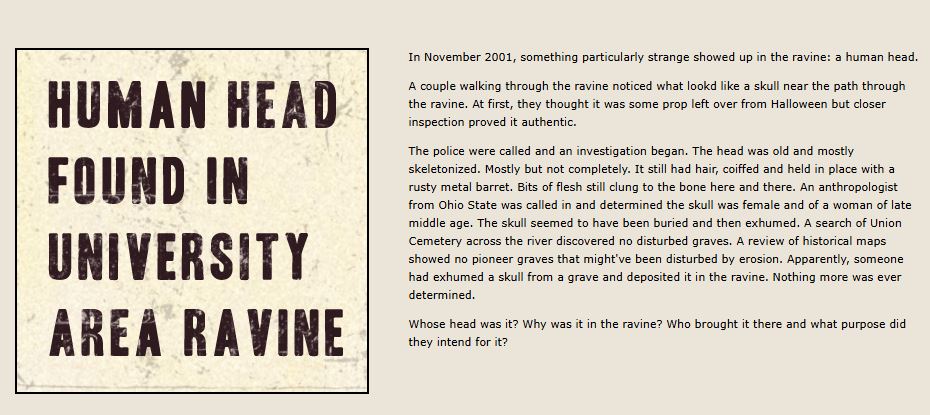
In November 2001, a couple walking through nearby Glen Echo Ravine noticed what appeared to be a skull lying near the path. At first, they assumed it was probably a Halloween decoration. When they looked closer, however, they realized it was real and contacted police.
The remains were described as an old, mostly skeletonized human head, but not completely skeletonized. Hair was reportedly still attached to the skull and held in place by a rusted metal barrette, while small amounts of tissue remained on the bone. An anthropologist from Ohio State examined the remains and determined that they belonged to a late-middle-aged woman.
Perhaps the strangest part of the discovery was what investigators determined afterward. The skull appeared to have previously been buried and later exhumed. Investigators reportedly checked nearby Union Cemetery for disturbed graves and examined historical maps for forgotten pioneer burial sites that erosion might have exposed, but neither provided an explanation.
According to the surviving account, investigators never determined who the woman was, where the skull originally came from, who placed it in the ravine, or why it was there.
That mystery is particularly interesting when discussing places such as Walhalla. Clintonville’s wooded ravines have accumulated stories about ghosts, witches, murders, occult rituals and other strange happenings for generations. Most of those stories are difficult to verify and some have been outright debunked.
But every once in a while, something genuinely strange is found in the woods.
Is Walhalla Ravine Really Haunted?
So, is Walhalla Ravine really haunted?
Personally, I don’t think it is; at least, I have never witnessed anything there myself. After looking into the stories surrounding Walhalla Ravine, many of its most famous legends are difficult, or impossible to support with historical evidence. The Mooney Mansion murders, for example, have been debunked, while stories such as the Walhalla Witch seem to survive primarily through local folklore and generations of retelling.
But that doesn’t mean I think every strange experience people report should automatically be dismissed.
There are things we experience that we simply can’t explain, and places like Walhalla Ravine provide the perfect setting for those experiences. The steep wooded hillsides, old houses, narrow road, bridge, flowing water, and relative isolation can make the ravine feel remarkably removed from the surrounding city. Walk through Walhalla after dark and it’s easy to understand how ghost stories became attached to the place.
Whether the unexplained experiences reported there have paranormal explanations is another question entirely. A strange sound in the woods isn’t necessarily a ghost, and a shadow between the trees isn’t necessarily the Walhalla Witch. Sometimes we simply don’t know what we saw or heard, and admitting that is different from immediately declaring something supernatural.
What I do believe is that Walhalla Ravine is genuinely haunted by its folklore.
The stories of Mooney Mansion, mysterious apparitions, strange lights, and the witch in the woods have been told and retold for generations. Some have been embellished, some have been disproven, and others have become so obscure that their origins may never be known.
Ghosts or not, those stories have become part of Columbus, Ohio folklore, and that’s ultimately what makes Walhalla Ravine such an interesting place to explore.